
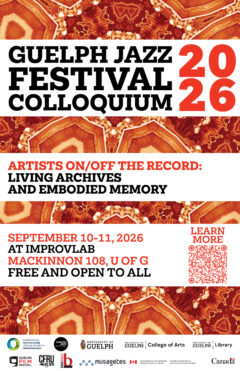
 Guelph Jazz Festival Colloquium 2026
Artists On/Off the Record: Living Archives and Embodied Memory
September 10–11, 2026
ImprovLab
University of Guelph
In what ways can/do artists engage with archival materials—those held in institutional and community archives as well as those typically referred to as ephemera—to interrogate the aesthetic and political dimensions of cultural memory? How can/do they generate new, future-oriented archives through creative practice, research, and community-based work? To what extent can/do they enact and expand repertoires of embodied memory to build and sustain community?
The 2026 edition of the Guelph Jazz Festival Colloquium explores archival heritage as a dynamic, open-ended process. Bringing together artists, scholars, and community practitioners, it considers how archives are constituted, activated, contested, and transformed by—and in the hands of—artists engaged in improvisatory worldmaking.
Approaching archives as both accrued and curated, inherited and self-generated, the colloquium also attends to archives as living and embodied. Through presentations, creative works, and discussion, it foregrounds diverse perspectives, community engagement, experimental practices, and innovative methodologies that illuminate the aesthetic and political dimensions of cultural memory while imagining archives as sites of future possibility.
This event is free and open to all! Please RSVP by selecting a free ticket via EventBrite.
Full schedule with abstracts follows; for a simplified schedule, click here.
GJFC Personnel
Colloquium Director: Eric Fillion
Colloquium Manager: Julia Busatto
Communications and Media Coordinators: Chris Worden, Sam Boer
Co-Technical Directors: Emma Bortolon-Vettor, Colin Harrington
Technicians: Steve Donnelly, Mike Hansen
Administrative Assistant: Madeline Morais
Program Committee: Eric Fillion, Curtis Sassur, Sam Boer, Emma Bortolon-Vettor
DAY 1, Sept. 10 (1:00 pm to 11:00 pm)
1:00–1:10 pm – Opening Remarks
Eric Fillion
1:10–1:40 pm – On the Exhibit XRoads
LuFuki
Moderated by Charlie Star
In this presentation, composer, cultural curator, historian, and guitarist LuFuki Ismaeel Dhul-Qarnayn will discuss his project XRoads: a visual archival gallery exhibit documenting the apparent and subtle influence of Islam and Islamic motifs in Muslim and Muslim-adjacent jazz musicians’ work. The music and their albums featured in XRoads are a living archive that translates the socio-political climate of their eras and serves as a sonic translation of the times and the Black experience. As LuFuki explians, “This research also explores music as embodied memory in the Black Muslim community, as there is a direct connection and somatic lineage between musical phrases, intonations, polyrhythm, and sound structures from West Africa to enslaved Africans held captive in America.”
A condensed version of the XRoads gallery will be installed in ImprovLab for the duration of the colloquium.
1:45–2:30 pm – The Improvising Archive: Reanimating Sonic Memories
Jesse Stewart
Moderated by An Kosurko
The Improvising Archive is a research-creation project that reconceives archival recordings of improvisation as materials for new, live improvisation. Drawing on a personal archive of visual and audio documentation spanning decades of improvisatory performance, the project treats the archive not as a repository of fixed past events, but as a dynamic, open-ended system that can be activated, recombined, and transformed in real time. For this presentation, Stewart will use the Reactable—an object-based digital controller in the form of an illuminated, interactive table—to remix archival recordings drawn from his performance practice as an improvising percussionist. By placing and rotating blocks on the Reactable surface, Stewart will create an improvised soundscape that brings diverse recordings into dialogue with one another, forming emergent constellations of sound. Recordings of solo improvisations on drum set, percussion, and found objects will be brought into dynamic relation with recorded group improvisations with collaborators including Hamid Drake, Douglas Ewart, David Mott, Pauline Oliveros, and William Parker.
2:35–3:05 pm – A Radio Active Community: Remixing Storytelling
David Dacks and Sydney Dacks
Moderated by Megan Arnold
This session examines the creation process of David and Sydney Dacks’ multimedia storytelling experiment, “A Radio Active Community.” This presentation, which premiered at Intersection Festival in Toronto in 2025, expands on David’s music documentary-making experience by digging into his own cassette archives to paint a portrait of early-1990s Toronto campus radio. Drawing on documentary inspirations such as Edward George, Mikey Dread, and Brian Eno, David uses not just music but advertisements, IDs, promos, interviews, and technical glitches as dynamic material for improvised storytelling. In performance, these elements are remixed with video content, text, and effects to foreground both the aesthetic density of underground radio culture and the context and political questions embedded in its preservation: whose voices are represented, what informs the viewer/listener’s experience, what are the responsibilities around consent and compensation (especially with respect to the high degree of Afro-Diasporic artistry content), and how memory shifts through time, mediation, and retelling.
The presentation for the Guelph Jazz Festival Colloquium will involve the partnership of the University of Guelph’s campus/community radio station CFRU 93.3FM!
3:05–3:20 pm – Coffee Break
3:20–4:35 pm – Archiving the Scene: Jazz Musicians and the Making of Community Memory
Keisha Bell, Brandon Hocura, and Brian Edward Jones
Moderated by Eric Fillion
Keisha Bell’s paper, “Archie Alleyne Archives: Remembering Black Musicians in Toronto between 1940-1960,” will discuss Archie Alleyne (1933-2015): a drummer, restauranteur, and philanthropist who ‘broke the colour barrier’ when he led the first jazz band to perform at the Town Tavern in 1955. Drawing upon Alleyne’s extensive archive, which was donated to York University in 2017 and contains photographs, textual materials, and audio and visual recordings that he collected during his lifetime, this presentation situates Alleyne as a black archivist and connects his interest in the black Canadian musicians who preceded him, with his advocacy for black musicians and Canadian jazz during his lifetime.
Brandon Hocura’s paper, “Adaptogenic Rhythms: Milford Graves, Self-Reliant Community Building, and His Archive of Heartbeats,” will discuss Milford Graves’ three decades conducting research on—and recording—heartbeats. Engaging in close listening to both Graves’ archive of heartbeats and recordings of his solo and collaborative improvisations, this talk will explore how the originary rhythm-force of cultural memory—the heart—provides an embodied ontology of vibration, an intersubjective modality that connects us with each other and to the motion of the universe.
Brian Edward Jones’s paper, “Paul Motian, Armenian American: Improvising in the Space Between Black and White,” will contend that Motian used his status as an Armenian American to float outside jazz’s black/white binary. Motian makes continual reference to his Armenian heritage throughout his unpublished autobiography and his “band books,” most often as an ethnic location of self-esteem. Still, as an Armenian American, he faced discrimination his whole life and was often mistaken as African American—which he took as a point of pride. As someone who was at times thought to be white and yet other times African American, what did Motian think about this in-between position? Beyond interrogating Motian’s racial identity, Jones will inquire into the ways in which musical improvisation can build social, political, and economic alliances, in turn acting as both a form of resistance and a strategy for survival in neoliberal times.
4:40–5:30 pm – Statesman of the Piano: The Music of Lou Hooper
Sean Mills, Eric Fillion, and Désirée Rochat
Moderated by Jordan Zalis
Statesman of the Piano: The Music of Lou Hooper, published by McGill-Queen’s University Press in 2023, examines the life and work of Ontario-born jazz pianist Lou Hooper (1894–1977), an early teacher of Oscar Peterson and deeply involved in the jazz community in Montreal and well beyond. This book sparks new conversations about Hooper’s legacy while shedding light on the cross-border travels and wartime experiences of Black musicians, the politics of archiving and curating, and the connections between race and music in the twentieth century. This presentation will feature a discussion of the book by two of its authors, Sean Mills and Eric Fillion, who will also share and discuss some of Lou Hooper’s music.
5:30–7:15 pm – Dinner
7:15–9:15 pm – Big Ideas in Improvisation: How can one use the music and equations of Sun Ra to thrive in the 21st Century?
Ahmed Abdullah and Monique Ngozi Nri
Moderated by Ajay Heble
This presentation examines A Strange Celestial Road: My Time in the Sun Ra Arkestra, the memoir of trumpeter Ahmed Abdullah, as a living archive grounded in artists’ journals, oral histories, and embodied experiences. Sun Ra (1914–1993) described his music and “equations” as a way of living for the twenty-first century. He mentored generations of musicians to continue this work, whether through the still-thriving Arkestra or through education, writing, and community cultural practice.
Abdullah spent a span of twenty-two years with the Sun Ra Arkestra. While performing at Ronnie Scott’s Jazz Club in London, he met poet, writer, and educator Monique Ngozi Nri, his wife and creative collaborator of thirty-four years. In 1995, they established Melchizedek Music Productions to help preserve and extend Sun Ra’s message. They subsequently helped build Sistas’ Place, an enduring cultural institution in Bedford-Stuyvesant, Brooklyn. Over twenty-five years at Sistas’ Place, Abdullah and Nri, in collaboration with poet Louis Reyes Rivera, developed Jazz: A Music of the Spirit: a twenty-first-century thesis for human empowerment through sound. Drawing upon Sun Ra’s teachings and the lives of nine Jazz progenitors, the thesis emphasizes improvisation, spiritual purpose, activism, self-determination, institution-building, and connection to Africa. Presented through scholarship, poetry, and song, this presentation argues that artists’ firsthand testimony is essential to preserving cultural memory and creating future-oriented community archives.
Ahmed Abdullah will be offering a book signing at The Bookshelf in downtown Guelph on Saturday, Sept. 12 between 5–6:30pm!
9:30–11:00 pm – Film Screening
Sun Ra: Do the Impossible (Christine Turner, 2026)
Moderated by Justine McCloskey
Following the presentation on the Sun Ra Arkestra by Ahmed Abdullah and Monique Ngozi Nri, the first day of the Guelph Jazz Festival Colloquium concludes with a screening of a brand new film on this visionary musician entitled Sun Ra: Do the Impossible! This documentary paints a kaleidoscopic portrait of this visionary jazz musician, composer, and poet, and the musical, historical, and philosophical currents that shaped him.
DAY 2, Sept. 11 (8:30 am to 4:00 pm)
8:30–9:00 am – Coffee and Refreshments
9:00–9:50 am – Workshops (Parallel Sessions)
Lara L. Hill, “Seeing Like an Improviser: Building a Living Archive”
Moderated by François Houle
This workshop will see visual narrative artist Lara L. Hill reflecting on “Chromascope,” her immersive documentary project documenting François Houle’s The Secret Lives of Colour since its 2021 premiere. Drawing on more than three decades across the arts, journalism, international development, and public policy, Hill will showcase how she explores agency in storytelling, aging, memory, and the evolving technologies in documentation and the arts.
Mike Hansen, “Disruptor, the Archive as a Constructed Fiction Through the Act of Co-Authorship”
Moderated by Jim Harley
This workshop explores the phonograph record as a communally re-mixable archival object. Building upon projects like “Broken Music – Destroyed Records” which Milan Knížák began in the 1960s, “Disruptor” takes as a starting point the deconstructed vinyl record, or LP, and asks participants to reconstruct the archive contained in this source material.
9:55–11:05 am – Secret Lives of Colour: A Conversation
Myra Melford, François Houle, Joëlle Léandre, Gerry Hemingway, and Gordon Grdina
Moderated by Joe Sorbara
Clarinetist, composer, and improviser François Houle debuted his project “The Secret Lives of Colour” in Berlin in 202—a suite of compositions and arrangements inspired by British author Kassia St. Clair’s book of the same. From ivory to obsidian, Houle explores the colour spectrum and its close historical connections to music, weaving a rich and suggestive tapestry of sounds. This project has evolved to include Myra Melford, Joëlle Léandre, Gerry Hemingway, and Gordon Grdina, who will all join Houle in discussing this project together in this special session.
Watch the Secret Lives of Colour perform as part of the Guelph Jazz Festival on Saturday, 12 September, 9:15pm at Royal City Mission. More details here!
11:10–Noon – Improvising the Archive/Archiving the Improvisatory: Medea Electronique and the Archive in the Post-Digital Age
Eric Lewis
Moderated by Amy Hwang
What would it mean to create a truly improvisatory archive, to allow archive users to be not just visitors to an archive, but active participants in its unfolding life, to view the archive as an improvising partner? In this presentation, Lewis will explore this question through the work of the Greece-based New Media Art collective Medea Electronique (now celebrating its 20th anniversary), which has long prided itself on the high quality of its documentation. Lewis will talk about Medea’s ongoing thinking about improvisatory archives as an example to pose a number of challenges concerning what The New Archive model can be. He will draw upon his own work with Medea, in particular the book From Fruit to Root that he co-authored concerning archives in a Post-Digital age, and present examples of how one can improvise with an archive, and so how an archive can move beyond being just be a repository of past works, but serve as a prompt, a partner, a co-author of new improvisatory works.
Noon–1:00 pm – Lunch
1:00–1:45 pm – Artist Communities and the Living Archive
Michael Palumbo, Curtis Sassur, and Simon Rogers
Moderated by Brandon Hocura
Michael Palumbo, “Before, During, and After: Documenting Improvised Music through the Exit Points Catalogue”
Founded in 2020, Exit Points has produced more than seventy concerts and released twenty-one live albums, including digital releases, a vinyl LP, cassette editions, and a recent initiative producing CDs on demand. Alongside the recordings, the project has accumulated a growing collection of concert photography, posters, production documents, stage plots, video documentation of audiovisual and dance performances, and a data-driven website that tracks performers, ensembles, production personnel, and concert histories across the series. In this presentation, Exit Points’ founder and artistic director, Michael Palumbo, reflects on the practical work involved in building and maintaining these archives. It considers the technical preparation required to capture high-quality recordings of improvised performances, the challenges of organizing and maintaining metadata, and the role documentation plays in helping artists remain visible long after a performance has ended.
Curtis Sassur and Simon Rogers, “Own Your Own Sound: Imagining a DIY Post-Custodial Archival Network”
This presentation will centre on the Toronto Information Network for Independent (TINI) Music Co-op (founded in 2020), which supports artists, fans, venues, and community members in documenting and preserving the histories of Toronto’s independent music scene. Working from a post-custodial philosophy, TINI seeks to strengthen the capacity of music communities to care for their own records while maintaining ownership, agency, and control over their stories and creative legacies. Drawing on five plus years of collaborative research, outreach, and community engagement, TINI co-founders and archivists Simon Rogers and Curtis Sassur will discuss the challenges and opportunities of building a community-driven archival network within a fragmented and largely undocumented musical ecosystem. The presentation will trace TINI’s work with artists, venues, collectors, and fans to develop practical tools and supports for documenting independent music culture, from performance ephemera and recordings to posters, zines, merchandise, and other forms of community memory.
1:50–3:10 pm – Resonant Bodies, Living Memory
Megan Harton, kat estacio, Monika Herzig, Kathryn Ladano
Moderated by Michelle Wilson
Megan Harton’s paper, “The Being and Breaking of Silence,”*** will discuss an interdisciplinary art installation that reimagined archival transgender narratives through immersive, sensory engagement. This interactive installation centred in a reimagined phone booth, where participants engaged with recorded stories from transgender elders via a handset, accompanied by headphone-delivered musical responses and collaged artwork. Drawing from the University of Victoria’s Transgender Archives, the work transformed institutional and ephemeral materials into a multi-layered, participatory experience, evoking the complexity of transgender identity, memory, and resistance. The project interrogated the aesthetic and political dimensions of cultural memory by centring marginalized voices and fostering active, embodied engagement with history.
kat estacio’s paper, “Resonant Inter-Remembering,” will explore the possible gestural parallels in percussive sound making and land-based tending from a diasporic perspective. estacio explains, “as a musician, I consider my kulintang (a community-based oral music tradition and percussive metal gong instrument) as an extension of my body which contributes to my experience of resonance and dissonance, and of silence and deep listening.” Exploring “the tension between the compulsory dependence on the body in order to create art, and the urgency of dreaming up new cripistemologies,” to use Johnson and McRuer’s term, estacio takes inventory from their “disabled, neurodivergent, queer, immigrant body” to develop “a vocabulary that aims to make a connection between embodied memory from performing kulintang and rice farming gestures accessed through ancestral memory,” asking questions such as “Am I still a percussionist if I refuse to strike a beat?”
Monika Herzig’s paper, “Transparent – Building Archives of Embodied Knowledge and Social Reflection”, reflects on her project based around raising the voices of the parents of transgender children. Herzig explains: “with an alarming rise in Transphobia due to political propaganda that had a direct and frightening impact on our own family, my project Transparent amplified and archived the concerns and stories of fellow parents in a suite of jazz compositions written, recorded, and published with the support of a Jazz Road Creative Residency Grant.” This presentation will guide participants through concepts of collecting and archiving testimonials and oral histories, share the project steps and musical as well as performance art results of Transparent as a case study, and provide a set of best practices on approaching projects and teaching of jazz as social activism.
Kathryn Ladano’s paper, “Anatomy of the Recovering Brain: Performance as Living Archive and Embodied Memory,” will discuss her multidisciplinary musical work for solo bass clarinet and fixed electronics that transforms traumatic brain injury survivor narratives into an embodied, performative archive. Created collaboratively by composer Frank Horvat using archival “Survivor Story” presentations from the Brain Injury Association of Waterloo Wellington (BIAWW) and the Ontario Brain Injury Association (OBIA), the project weaves together six lived experiences of brain injury through music, speech, memory, and performance. This presentation examines how artistic practice can activate archival materials beyond documentation, transforming testimony into living, affective experience.
***Please note that the presenter provided the following content warning: “This presentation contains discussions of historical and current experiences of transphobia and homophobia. There is also one audio excerpt quote that mentions World War 2 and the Nazi regime, there is one statistic and another quote that mentions race discrimination, another that mentions a police raid. Of course, these topics can evoke strong emotional responses. I invite everyone present to listen to your own bodies and minds throughout this presentation. If at any point you notice yourself feeling uncomfortable, triggered, or experiencing heightened emotional responses, I welcome you to practice whatever self-care strategies work best for you.”
3:15–3:50 pm – We Are Archives
Georgia Simms and Heather Cornell
Moderated by Rebecca Barnstaple
From two different dance performance traditions, but with a shared love for rhythm and improvisation, Heather Cornell and Georgia Simms will reflect on the consequences of embodied archival consciousness through an unscripted, public conversation as performance. Through this creative work, they will investigate notions of inscription, bodily transmission, non-linear time, and what kind of remembering gets prioritized when sharing dance across generations. Their score allows for standing, sitting, and other forms of body language to emerge in an assemblage of collaboration, inquiry, and relating across genres.
3:50–4:00 pm – Closing Remarks
Eric Fillion
4:00–6:00 pm – Colloquium and Festival Reception
Hosted at Brothers Brewing Company (5 Wyndham St. N., Unit A, Downtown Guelph)
Following the reception, the Guelph Jazz Festival will run from Friday, September 11 to Sunday, September 13 in Downtown Guelph.


